About Me

My photo
Vancouver, British Columbia, Canada
I am a beekeeper in Vancouver, British Columbia. The bees forage all the way up Stoney Creek by Burnaby Mountain.I am committed to not exposing my bees to chemicals for pest control or a quick fix to their health. I am committed to keeping them without treatment and I am working very hard to make this a success. I prefer my bees to feel like their sister's in the wild and a little bit more comfortable with the care I provide. Enjoy the pictures and follow my beekeeping endeavours.

Monday, May 23, 2011

New Project: Foundationless frames and small cell foundation in brood chambers

I have named the new hive, Molly Brown (MB). She takes over Matilda's equipments and since all the equipment are marked with a M for Matilda, it made sense to keep the 1st name starting with a M to organize the equipment and to avoid interchanging equipment to prevent diseases spreading from one hive to another.

Queen Molly Brown has been laying very well. She was released from her queen cage on May 14th. By May 20th, she has filled up five frames with eggs and the oldest larvae is 6 days old. She started laying almost one day (May 15th) after she was released. She is laying at a rate faster than the bees can build comb cells since most of the five frames are all foundationless.


I started off the package with one small cell 4.9mm foundation and 4 frames with starter strips. The 3rd day after the package was installed, I checked the hive and the frame with the full small cell foundation collapsed. It was a good thing I discovered the collapse, as the bees were already building their own comb that were not aligned with the frame. I replaced it quickly with a foundationless frame instead. The small cell foundation being made of pure beeswax is much softer and fragile than plastic foundation but the greatest advantage is the bees builds comb on it immediately. On 20th May, I added two more frames with small cell foundation, this time properly securing the foundation with popsicles and a touch of wood glue to prevent another collapse, by 22nd May, the bees already built comb on 30% of the foundation on one side of each frame. Its the fastest adaptation of foundation I've seen. There were so much stores on those frames that the foundation was starting to warp to one side coz of the weight imbalance. I rotated the frame to balance out the comb building.

Goal:
The main goal of the small cell 4.9mm foundation is to have the egg to bee development stage of 21 days shortened to disrupt the varroa mite life cyle.  The 4.9mm cell creates a much tighter fit when the larvae grows, leaving less space for varroa mites plus the cell gets sealed earlier which tightens the opportunity for varroa to enter the cell to lay eggs during the pupae/development stage of the honey bee. The common honey bee is a perfect host as the varroa mite takes advantage of the 12 day pupae stage of the bee to lay its eggs (up to 21 eggs), the eggs to hatch, mature as mites and then mate while still in the capped cell. Only the matured and mated female mites leave the cell, the male mite and the immature mites dies. The female mites leaves the cell to latch itself on the nurse bees, the mites feed on the new host and then goes to another brood cell just before it gets sealed to lay more eggs. So the small cell foundation is to spoil this cycle. It is known that the AHBs have shorter development time and fewer mites can come to maturity.

Desired Result:
I've also heard that the bees emerging from 4.9mm cell have smaller bodies and a longer wing to body ratio. My guess is that the bees may have better energy efficiency when they get to their foraging stage. Maybe the smaller forager bees live for an extra 2-4 days which would mean a higher amount of nectar and pollen stored in the hive.

Reality:
I don't think the gals in Molly Brown are following the 4.9mm cell size. They seem to be building over the prescribed cell size. But it is still to early to really say but I will be updating this in a few days time with proper measurements. Here you can see the 4.9mm starter strips that have not been built over on the left side and on the right side, the cell sizes are bigger.

For normal plastic foundation the cell size is 5.4mm. I have noticed that for natural comb built on foundationless frames the size varies from 5.1mm-7mm. The larger cells up to 7mm were noticed on the periphery of the frames where the bees store honey and pollen. The cell size decreases as it gets to the center where brood is nursed. I thought this was very a smart building plan. Larger cells for more food storage and smaller cells to nurture a small honey bee.

The picture below is comb built within 3 days on all five frames.

Wednesday, May 11, 2011

A new start to everything

All my original hive that started out in 2009 Summer have all perished this winter. I had a 100% overwintering rate in 2009/2010 winter and a 100% loss in 2010/2011 winter.

Today I am restarting beekeeping with a package of bees from New Zealand from Bartel Honey Bee farm brought into Canada by Urban Bee Supplies. Doug Hansen, the President of the Burquitlam Community Organic Gardens went with me for the pick up.

This is the package bees in Arataki tubes in the trunk of Doug's car going back to the community gardens.

Upright view of the package in the tool shed at the gardens. 


I am adapting to small cell and foundationless frames in the brood chamber. Lianne Shyry that runs Two Bees Apiary supplied the small cell foundations. We are both trying this new method out and will be comparing notes. Its an excellent feeling to be partnering with Lianne and Garrett in this new experiment. The small cell foundations were specially made out of beeswax. They were the most delicate foundation I have dealt with and I am sure the bees will love it. I am yet to see it work. Will report my observation in the weekend. I have noticed that the plastic foundation always seem to take a while to get the bees going with building comb especially when the frames are situated at the ends.

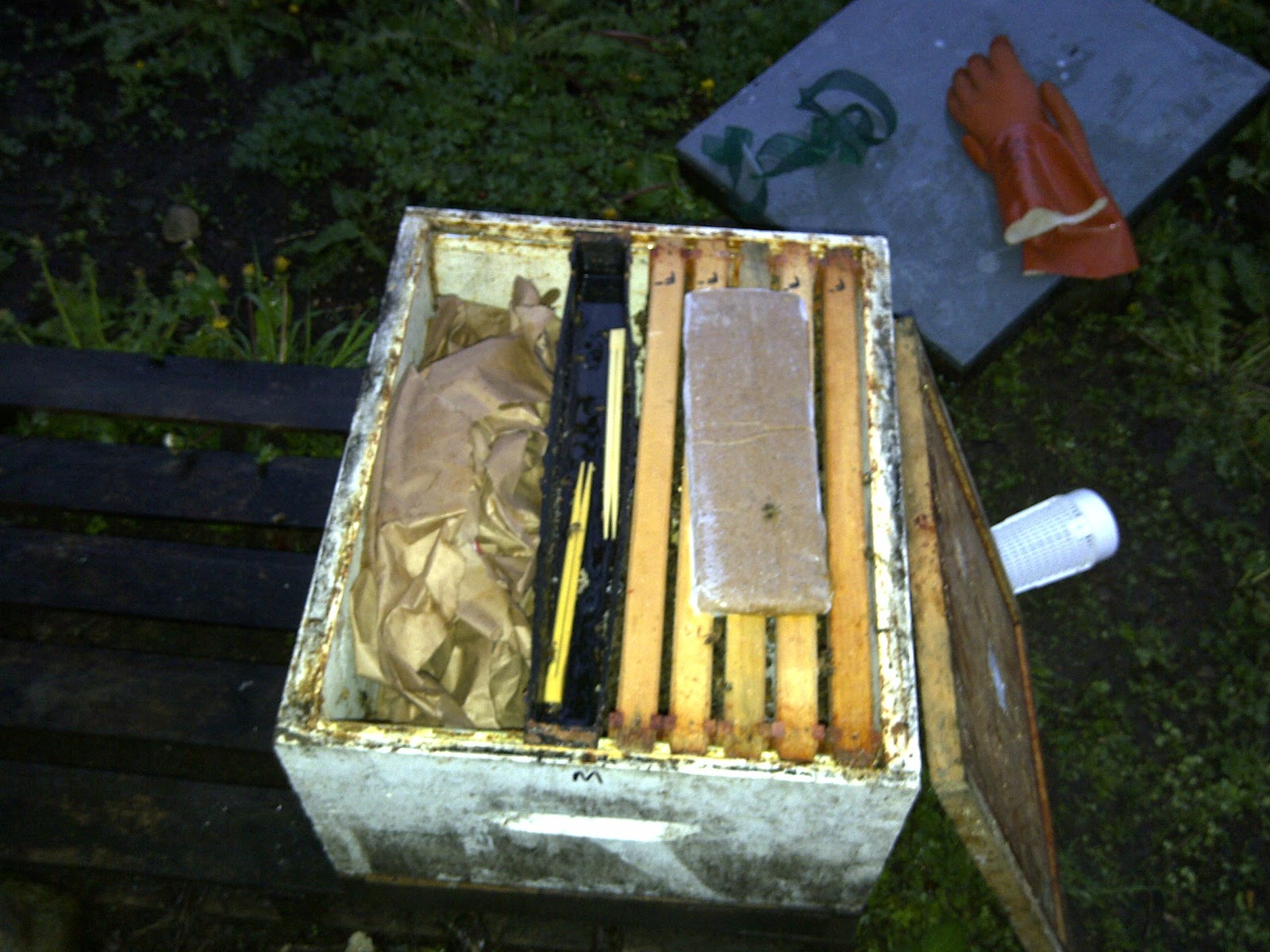
This is the package already installed. Placed them in a deep super with 5 frames with 1:1 sugar syrup and a pollen patty. On the left is crumpled paper to fill up the extra space to prevent the bees from building comb.


Wednesday, April 13, 2011

Matilda is a living dead

It is so sad that my dear Matilda, my last hive that came out of winter the 'strongest' bcoz the rest died, may not make it as well. In the previous post, I mentioned that I observed the queen just started laying. So on April 10th, I went to the community gardens with confidence that the eggs would have hatched and would now be capped. That did not happen because the eggs did not hatch. I saw the eggs from MArch 26th still looking like a tiny piece of rice standing upright. This time there were more eggs that the queen has laid." Oh Matilda, why didn't you start laying earlier when there were more bees? Not all your fault, I know." The cold weather and the rain has been so persistent caused a lack of flowers in bloom or caused very late blooming periods.  As the days pass, the bees that are present will expire. Most of the bees in there right now are really old and are almost 6 months old.

I was told that the eggs are not hatching because the humidity in the hive is too low and there are too few bees to maintain that level of humidity and temperature to incubate the eggs to hatch. There was also a claim that for a very very weak hive to survive and build brood. A minimum of 300 bees are needed. I think Matilda has about less than a 100 bees left.

I must say keeping bees in Vancouver's weather has been challenging and of course I'm still a 'wet behind the ears' chemical-free beekeeper. I now understand why they say that you only know how to keep bees after going through at least 5 winters. Its the skill in prepping the hive for winter, finding signs of weakness, knowing what to do to minimize losses and etc. For 2 years in a row in spring, I had troubles in the hive. Last year, Matilda swarmed without me detecting and I had a virgin queen that did not have a week of good sunny weather for mating. So I ended up with a drone laying queen. But actually, that swarming maybe the reason why Matilda is still surviving because it had no laying queen for almost one month and the varroa mites cannot reproduce with the young bee larvaes because there were none for a month. The mite levels probably dropped drastically for that period. Whereas Bombay that got hit hard with Nosema Ceranae, had a high mite count throughout the summer and going into winter. Bombay clearly did not have varroa resistant genes and it would have needed a few season to survive to build such a resistant. The mites in Bombay then made new bees emerging for winter to become weaker and became the vector for disease to fester as the bee's immune system has been weakened.

This morning, I decided I maybe could save Matilda when I placed an order for a package of NZ Carniolan bees which a shipment was arriving today and I could immediately use the heat from the new package to warm up Matilda by placing Matilda over the new packaged hive. THe hive will be separated by a cloth the bees cannot chew through but heat can pass through. I was going to pick up the bees at 5pm today but I got a call at 3pm that the shipment did not have enough packages and my order had to be delayed. DANG! I appreciated the call from Lindsay. Had so many bad experiences from bee suppliers in Vancouver. Recently, there has been more bee suppliers who are younger and more oriented to the hobby beekeeper. The lousy suppliers I had dealt with were mostly commericial beekeepers and running a retail shop for hobby beekeepers as a side job. Hence a subpar service or being dishonest. I called Urban Bee Supplies for the NZ package and Lindsay Dault was informative, responsive and friendly. Even sent me a video on where the bees were from and how to install the package. Excellent. I hope she does well and call me soon for a package of bees.

Saturday, March 26, 2011

Mid-March still cold and no brood

I was hoping my worries for Matilda will be over with some brood. Purple Crocuses have been in bloom but nothing really much is in bloom since mid-March, although more and more flower buds are about to burst. Cherry blossoms are blooming at glacial speed. Last year this time, cherry blossoms are about to end. There has not been enough blooms to stimulate the queen to start laying. On March 14th, I added 1:1 sugar syrup mixed with Echinacea, peppermint and lavender tea and added a new pollen patty. The tea is not some special recipe, they were tea leaves given by my friend Andrew and it is so fragrant that I hoped it stimulates the bees to feed.  I thought at least by the 16th of March, the queen will start laying and I would expect to start seeing sealed brood by today. Instead, I saw that the queen just started laying yesterday. The eggs were upright and at least 100 eggs were laid. The queen was also found on the same frame. Well at least something and hope they are fertilized eggs. Doomed if they came out drones. I guess I would have been even more worried if I didn't see eggs by now. So I can expect to see the first batch of workers/ to emerge by April 16th. The next 8 days are crucial for the overwintered bees to do their best in making sure that most of the eggs laid will emerge into healthy new bees. By then I would also know if they were fertilized eggs. I also noticed that some cells had 3 eggs laid in it. Wondering why? Overall, the queen's laying pattern was good. Got an answer from BeeMaster Forum, that the queen when just starting to lay eggs will accidentally lay 2-3 eggs in a cell and nothing to be concerned about.

I have figured that artificial feeding is not a sure way of stimulating the queen to start laying. It would be the lowest average temperature of the day and the amount of natural forage available for the bees to bring back pollen. The artificial feeding as I understand is to sustain the hive in case the natural elements are lacking to provide with the food demands of the colony and may rely on it to maintain its current production of brood. 

These are some of the gorgeous Purple Crocuses that bloomed around the community garden on March 20th. These flowers were just about 5m from the hive and the bees were returning with heavy bags of pollen to the hive. 


Was cleaning up supers from Bombay that was infected with Nosema for Iotron treatment on Tuesday. Iotron is a name of a company that provides services to beekeepers, horticulturist and any food/medical business that needs to sterilize equipments. They use electromagnetic radiation to sterilize the equipments as the beams destroys the DNA molecules in the bacteria.  I was scraping off all the sugar syrup that were stored in sealed combs from last fall into the garbage bin. It was heartbreaking to remember how well the hive was doing last September and wasting all the golden beeswax that had sugar/honey. This had to be done as I was told that the electron beams don't penetrate combs with honey, or maybe it could be too heavy for those loading the conveyor belt or the sugars/honey could be carriers of the bacteria. Anyway, whatever it is I would like to not have a repeat of Nosema for the new nucleus colony I have ordered. Its painful to see bee poo all over the frames and knowing the bees died horribly. Read previous post on why they died horribly.

On a good note, Matilda can turn out to be a mite and disease free hive if it does well. The long dearth of brood (early Dec-March 25th) in the hive may have wiped out all the Varroa mites. I am really looking forward to manage a hive without any mites. So much less work, so much more healthy bees and definitely a higher survival rate for overwintering hives. Too good to be true? But it is a possiblity! For future hives to come, I would definitely be trying a method of caging the queen for about 13-15days to stop her from laying to control the level of mites in the hive. One more weapon to control mites without chemicals. 


Sunday, February 20, 2011

Whats left.

Yesterday was a gorgeous sunny day hitting the highest of 5 deg Celsius. I was excited to check the hive after such a long 2 weeks of rain and cold weather.

As of know I already know that Camille has died of starvation.

 Matilda is still doing well. She is all I got right now. I gave a pollen patty. I was considering not to give as the hive still had tons of pollen gathered from last fall in the lower chamber. But I guess, it may be too cold still to venture to the bottom chamber. Please do well Matilda! I need the weather to cooperate. I wish for more warmer and sunny weather.


Bombay is a goner too. Lost her to Nosema. I've collected some bees to send to the Ministry lab for testing. Evidence of Nosema were everywhere. I would like to know if this is Nosema Ceranae or Apis. I treated Bombay with Fumagilin and still Nosema affected it. I noticed that bees in the hive had somewhat of a similar way of dieing. Alot of the bees had the middle left leg sticking upwards. I am guessing that is how the Nosema bacteria in the guts ruptures through a nervous system that kills the bee and also causes that leg to rise. I could not get a clear picture as they were blurred from a camera that has lousy focusing. I made the picture huge so maybe you can see what I'm describing. Scroll to the right and see some of the evidence of Nosema.
When observing the frames, I can tell it was a horrible death. Bees having to hold their bladder from December to February and then getting killed by the bacteria in their own guts. The high number of bees that got affected by the Nosema, the hive could not maintain a warm cluster. The rest of the bees surviving were probably left stranded wherever they were, either in a paralyzed state coz of the cold and others who got hungry and were in a spot where the combs are empty probably did not have enough energy to walk to find food even if it was just 10cm away and then died of starvation. I saw bees with their butts sticking out of the comb probably trying to keep warm and licking every last drop in the comb at the same time. And may have even froze in the comb. Tragic!


I decided to quickly clean out the hive screen bottom boards and clear out all the dead bees before fungus grows. The boards were caked with a 2 cm deep of dead bees and mostly covered with fungus. I made sure I cleaned them out while I was upwind. Really don't want to breathe in any of that fungus spores.


Matilda you are my only hope! All the gloom and doom has to stop with great memories of summer. :)

Wednesday, February 9, 2011

Currently Reading: Honeybee Democracy by Thomas Seeley.

Winter is a good time to pick up on more knowledge while there ain't so much work to be done in the hives. THere is also less I could do anyway so I just borrowed Honeybee Democracy by Thomas Seeley from the library. Its understanding bees swarming in a whole different angle. I"ll add more to this post when I turn more pages in the book. I found this video that decoded the illusive waggle dance.


Sunday, January 30, 2011

Hive Status Jan 30th

Today is the 1st sunny day after a long week of rain. I have been aching to visit the hive  All the short sunny spots that occurred this week were on weekdays and I was at work. Receiving emails from fellow beekeepers noting that their hives were bringing in pollen made me envious to check on how mine were doing.

I opened Bombay first. There was a small cluster in the upper brood chamber and lots of honey left. At least 6-7 frames of honey. I was hoping to find the cluster extending down to the lower brood chamber as it seems too few bees are left. I lifted the upper brood chamber to take a peep and there was nothing below. I had a bad feeling if they would survive or not. I rotated one frame where the cluster was closest, to get access to more honey and shifted the remaining pollen patty left behind in November over the cluster. Hopefully, if the queen is laying they can slowly replenish their numbers. I lifted the entrance reducer to clear some dead bees and there was so many dead bees. The screened bottom board was just chalked up with dead frozen bees. I closed up the bottom to maintain their heating system just in case the dead bees were somewhat of a wind/cold breaker.

I opened Matilda next. The hive looks better. At least 2 frames of bees remaining and tightly clustered. Honey storage levels seems the same. At least 6-7 frames left. Did not need to shift any frames as the cluster was on a frame full of honey. After opening, they started to fly out to gather pollen from catkins hanging from the hazelnut tree.


Lastly, I opened Camille. Clear dead out. It was as expected but I was hopeful that it wouldn't come to a tragic end. From the previous post, the hive only took in 3 gallons or less of 2:1 sugar syrup. Below is what is Camille. The bees were not frozen. The bees at the top were dry and it seemed that they died together just 1-3days ago.