About Me

My photo
Vancouver, British Columbia, Canada
I am a beekeeper in Vancouver, British Columbia. The bees forage all the way up Stoney Creek by Burnaby Mountain.I am committed to not exposing my bees to chemicals for pest control or a quick fix to their health. I am committed to keeping them without treatment and I am working very hard to make this a success. I prefer my bees to feel like their sister's in the wild and a little bit more comfortable with the care I provide. Enjoy the pictures and follow my beekeeping endeavours.

Tuesday, August 3, 2010

Varroa Testing: Alcohol Wash vs Sugar Dusting method

It is the time of the year to determine varroa mite levels in the hive. I want to know the mite level to understand the severity of the infestation to determine the frequency of how often I should be treating the hive once I pull the supers out for harvesting.

In beekeeping literature, there are several methods to test for varroa mites and the method widely practiced in Vancouver is the alcohol wash. An alcohol wash requires you to capture 300bees about 1 cup into a bottle and pour anti-freeze wiper fluid (alcohol) to remove the varroa mites from the captured bees. The alcohol is poured out and the varroa mites flows out with it. You then count the varroa mites and multiply by 100 if you don't have brood or multiply by 600 if you have plenty of brood. The bees to be captured should be from the brood frames, so preferably nurse bees or drones.

I have been against this idea of alcohol wash and I was putting the idea of testing for varroa mites away all together. I thought why drown 300 precious nurse bees for this method. Nurse bees are the main food provider of the queen bee and growing larvae, as nurse bees vittelogen levels are the highest which is a component of the elixir we know as royal jelly. As some would know, the queen been is only fed with royal jelly. Nurse bees also support the growing larvae with worker jelly which are very demanding. At any one time in a healthy hive with a good laying queen, there are 8000+ larvae calling out for food.  So drowning 300 nurse bees will reduce the workforce for an essential task in the hive. It is also wasteful killing the bees like this and not part of my beekeeping philosophy. As all other mite testing methods known in the field does not yield accurate mite levels. Sugar dusting is the kindest method. So recently, I stumbled upon the apiculture section of the Ministry of Agriculture and Lands of British Columbia website about varroa testing and I found the method that fits my style of beekeeping. Click here on Varroa Detection Method to reach the site.

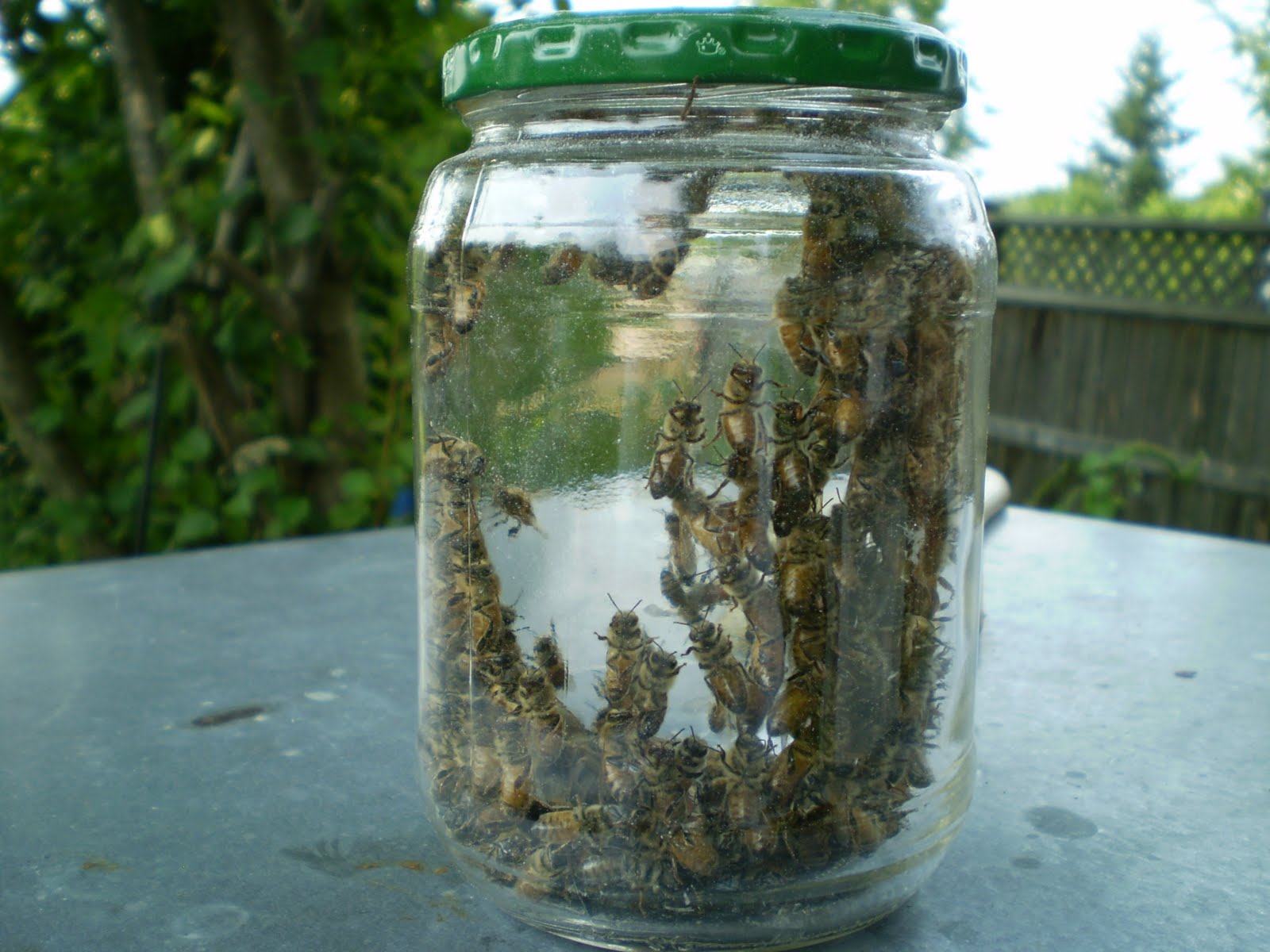
Icing sugar method about 100-200 bees in the jar

The Icing sugar method requires a wide mouthed jar with the cap cut and a 1/8th wire mesh fitted onto the cut cap. I used a pickle jar and used a can opener to cut a large hole on the cap. I also bought a wire mesh colander from Daiso for $2. I cut the wire mesh out of the colander and there was enough mesh to create another 3 more testing jars. I used super glue to stick the wire mesh on the cap. Wait for it to dry for 15 mins and I got my wide mouth jar ready for varroa testing.

Find a frame with open brood with lots of nurse bees and be very sure that the queen is not on the frame. I think bees found on open brood frame is better for this method than bees on capped brood frames because the varroa mites attached on those bees are waiting for the opportunity to enter the brood comb before it gets capped to lay their eggs onto the bee larvae. The newly hatched varroa mite will then feed on the larvae. Therefore the infestation levels should be highest on frames with open brood as it has the best conditions for the varroa mite to continue its life cycle. After capturing enough bees about 100-300 or 1 cup of bees, cap the jar and sprinkle 2 tablespoons of powdered sugar through the wire mesh. I think even flour can be used, though I have not tried it yet. I took a video to show how I executed the testing method. I was really rough with the bees in the jar. Don't mind me. I feel bad myself but it is only to shake out all the varroa mite for an accurate count and to give the unlucky bees in the jar with varroa mites relieve once the mites gets detached. None of the bees died in this method. Even if some got injured and eventually died, it would be less than 10 compared to a 100% kill if using the alcohol wash. After shaking the sugar out of the jar, release the bees at the front of the hive entrance. Remember that nurse bees have never flown out of the hive before and may not know how to fly back to the hive if they get disoriented. So always return the bees as close to the hive as possible. Enjoy the video. The bees in the video are from Matilda.


I tested Bombay first and then Matilda. The results of the testing are

Bombay : 1 mite/100bees = Low infestation level
Matilda : 8 mites/100bees = High infestation level

Click on the picture for an enlargement. After all that shaking. The red/black specks are varroa. A white paper backing makes it easier to spot the red Varroa mites.


Was wondering why Matilda had such constant high infestation levels since last year. Even before I had problems with the queen. I am still wondering why. It is still too early for Queen Matilda II to correct this. It is just barely a month ago she took over from the drone laying queen. The drone laying queen has probably created the perfect condition for varroa mites to reproduce. Varroa mites love to lay their eggs and grow up with drone bees because the drone combs are more roomy due to the larger size of the drone compared to the tight comb of the worker bee and the pupae stage of the drone is longer than the worker bee by a couple of days. The extra days allow the baby varroa to feed on the host longer. Matilda definitely needs to be treated the 1st once the supers are off on Aug 15th.

If you like this post. Leave a comment or click on some of the advertisements on the right. Thanks for reading this post. Hope this was helpful and a plus if it was an interesting read.

Read more on the Sugar Dusting Method: http://www.cals.ncsu.edu/entomology/apiculture/PDF%20files/2.03.pdf

Hive Inspection on 24th July

Did a normal hive inspection on 24th July before 2pm. Weather was sunny. I did not have much time so I laid out my task of the day so I won't forget what had to be done.

Task
Matilda

- Remove brick and move hive onto wooden pallets
-Move Queen excluder over 2nd empty super


Bombay
- Mark Queen
- Collect 100bees for varroa testing. 


Camile
- Normal Check

Inspection Notes:

Camile 
2 frames of honey/pollen
1 frame of capped brood
1/2 frame of eggs and brood in all stages
Pollen patty finished in 2 weeks. Installed patty on 10th July.
Queen spotted. Nucleus colony healthy. Spotted dozens of Varroa at bottom board.

Matilda
5 frames of honey
Queen Spotted and laying well

Bombay
No smoke used. Bees were still calm.
3 frames of comb honey and 4 frames of honey.
Marked queen. She seemed a little unconscious after being marked. I must have held her down a little too hard. Was really worried if she would do fine. After about 3 minutes, she got revived and ran around the frames. Ensured all legs were intact. Spotted lots of bees with Deformed wings.  Suspect varroa level high. Must do Varroa testing on next inspection. Brood comb that was freezed 3 weeks ago have all been removed.
Noticed 3 frames without foundation being contructed. Bees were holding on to each other like acrobats forming the semi-circle shape of the foundation they are creating.
Good pollen flow.

Sunday, July 18, 2010

Success in Requeening Matilda and Bombay

I have to thank James Macdonald the owner of Armstrong Apiaries for rescueing Matilda from being shut down and that allowed me to maintain my 2 hive operation. Actually, I have 3 hives now as the former queen of Bombay rules the newly set up nucleus colony, Camille. I called James on Saturday morning 4th July and left a voice message to order queens. He called me back within an hour or two and was very assuring that he would be able to solve my queen problems and he guarantees gentle quality queens. He sent out 2 queens by priority mail on Monday afternoon and they arrived on Tuesday morning July 6th in the package below.

The brown bag with holes is where the 2 queen cages were packed in. I picked up the package from the Post Office at 9am and brought them to work. After work, I installed one of the queens into Matilda who had the drone laying queen removed 2 days before.


My new queens travelled by Canada Post comfortably for 446km from Armstong to Coquitlam. They were in transit for less than 18hrs.

In the queen cage there were 4 attendant workers and the queen. They were moving in the cage in a circular manner all day long. Super active and very different from the queens from West Coast Bee Supplies. The pheromone from the new queen was strong, that she already had a bee from Matilda who could not wait to pay her allegiance to her future queen. This bee on the cage was so mesmerized feeding the new queen that she did not even care what was going on around her.


The bees of Matilda could not wait to free their new queen and was instantly busy eating the candy barrier. Do you notice the majority of the bees  in the photo facing the cage? They were clearly excited about their new queen.


3 days later, the new queen of Matilda has been released. This photo was taken yesterday. Notice the circle of attendants around her. She definitely commands alot of respect.  From reading the frames she started laying almost the moment she came out of the cage as the oldest larvae is already about 8 days old. Look at the size of her. She is HUGE! Her laying pattern is excellent. I saw 2 frames of freshly laid eggs. What a feeling of satisfaction that the new queen has convincingly taken over the rule of Matilda. All my worries since April have been set aside and I can sleep well at night knowing that Queen Matilda II is running her hive well =).  She moves around the frames in a steady and confident pace but when I attempted to pick her up to get marked, she can really sprint. I caught her anyway, firmly and carefully on her thorax.


She is now marked. She is in my queen marking cup waiting to dry the marker point on her back. The paint I use is a non-toxic ink. I marked her green which was 09' colors as I only have 2 hives and the color does not matter. If I had many more hives, I would follow the colors of the year. I mark my queens to ensure that if the hive created another queen to supercede her, I'll know that happened.

By the way, this is my 2nd hive inspection without gloves and have not got stung. My attitude towards them have changed. I am no more afraid or nervous around them, which I think they detected it before and was aggressive then. Now I am confident of my handling of the frames and  less bees get injured on each inspection. Maybe one or 2 still. It used to be more than 10 injured bees per inspection. To safer and happier beekeeping for them.

Poppy Flowers in Bloom

Last Saturday, 10th July, I dedicated my whole day to weeding my garden plot and when I got to the gardens I noticed Poppy flowers were in full bloom. It was beautiful. I also heard buzzing noises coming from the flowers and saw that my honey bees were buzzing all over them. I read before that bees could not see red and were not attracted to red flowers but poppies although have bright red petals have yellow/white pollen stamens and yellow ovules which are color spectrum that bees can see. The purple design on the poppy is also another color spectrum that attracts them. This variety of poppy below has similar characteristics to the Afghan Poppies.


I noticed that when the sun is at zenith, it is the best time to take pictures. Positioning yourself to capture the shot is easier as you don't cast a shadow on the subject, the subject of the photo comes out very clear and it is also easier for the camera to focus.


Above there are 2 bees working in this flower. If you were a bee, wouldn't it be fun playing in this deep flower with lots of sweet poppy nectar.


Bee: Should I go home or visit another flower?


Bee: Another Flower!!!  This is an Oriental Poppy above.


Hope you enjoyed the photos.

Tuesday, July 13, 2010

1st Official Hive Inspection and creating a Nuc

On Sunday July 4th, Jacquie Bunse, the Bee Inspector from the Ministry of Agriculture of BC visited my hive for a hive inspection. I was delighted to have her over to be my mentor for the day and it was great to be able to ask all the questions I had about my hives. Jacquie has been a beekeeper for almost over 20years now and she was so willing to share as much knowledge she possibly could. Even after driving from Mt Currie in Pemberton to check on an apiary before coming to my apiary in Coquitlam, she seemed full of energy. She amazed me from the get go. She was not wearing gloves while going through my frames! I told her my bees can get aggressive especially that Sunday when the clouds were hanging low and it has been cool all day. I have been afraid of not wearing gloves for almost a year now. Getting stung on the fingers is really painful. The last time I got stung on my fingers was on my thumb and the next day it swelled so much that it feels like the skin around the thumb is going to explode. Since then, I have been using latex gloves that are thick enough to not allow the bee stings to penetrate the material. I was skeptical that she would not get stung and she did not. Well, she pointed out why my bees were aggressive towards me. She noticed I pulled the frames out too fast and it causes the bees on the other side of the frame not facing me to roll over and fall to the screened bottom. When they fall, they get agitated and start butting heads with me and try to sting wherever they can. So the trick was to take 1 or 2 frames out and lay it on the side of the hive to have more space while bringing out each frame and then pull out the other frames....SLOWLY! Since then, my last 2 inspections since July 4th, I have mustered the courage to not wear gloves. It was such a different experience beekeeping w/o gloves. I could feel the bees licking and crawling over my fingers,less of them got squashed and I felt more connected. I finally got to experience that my bees are really friendly and inviting as long as I had presence of mind while working with them. I owe this better experience of beekeeping to Jacquie. Thanks alot!


She thought me how to create a Nucleus hive which I used the replacement queen that Bob gave me, which by the way was a virgin queen that died in the cage when I checked again on July 6th. Probably because Bob did not add any attendant bees in the cage. I was expecting the virgin queen to die somehow as I knew not having attendants of her own, she would starve. Anyway, we created a 3 frame Nuc. We picked out a frame with honey and pollen stores on both sides, second frame with brood in all stages (some capped and some open brood)


and last frame with more brood and store. All the adhering bees on the frames were transferred over and we were looking out for frames that had mostly nurse bees.


Picked out another 2 more frames of nurse bees and shaked them on to the nuc box.


Thats a complete 3 frame nuc.


At the end of the hive inspection, no European Foul Brood or American Foul Brood was found. So the result is a positive :) My hives are healthy and is in good shape to receive their new queens. And I ended up with one more hive :)


Friday, July 2, 2010

Requeening Matilda Failed

The queen I bought yesterday has died. She died from suffocation on the candy. There was too much candy in the cage. She 1st got stuck half an hour after picking her up but she freed herself. The picture taken yesterday shows she was alright. At 630am, when I checked the queen cage, she was stuck. I was hoping that she would free herself again later. Every hour I checked. I had such a narrow view of her through the cage as her attendants were blocking and she never moved or struggle. When I got to the gardens, I had to investigate rather than wait 3 days till the bees eat the candy barrier to release her. I cut the cage open and found her head was covered with candy that has hardened. I tried reviving her by cleaning the candy off using Saline solution but it did not work. I'm at a lost right now. I'm too frustrated to go back to Bob and get back my $25. When I called him to tell him about the status of the queen, he blamed me for my handling. I really don't care what he says. Its as if I wanted to kill the queen. Matilda is now queenless. Will probably have to combine the hive soon and that would have to be done by Sunday. Absolutely dissapointed!!!!!!!!!!!!!!

My resolve is now stronger to be self sufficient in rearing my own queens next year.

The Queen has arrived

Just like the Queen of England who is in Canada now for Canada Day, my queen has arrived from West Coast Bee Supplies. What a day. I've been calling Bob about a month ago asking for queens. I think I've bugged him over the week several times checking if he was ready to sell me one. So finally on Tuesday when I called, he said he's got some. I made arrangements to reserve a queen and to pick it up today 1st July. I was excited. Finally I could see the light at the end of the tunnel with the drone laying queen problem I've had for the past 2 months. Can you imagine, Matilda has been with a drone laying queen for 2 mths and on Tuesday when I checked, they kicked her out, I hope, since I'm introducing a new queen. Well there can be more messy problems in the hive and mine aint' that bad. Nao who I met coincidentally at West Coast Bee Store was telling me she had her 2nd swarm. Thats what I call a messy problem. Glad that she managed to catch her swarm again. I'm most afraid now of a laying worker or worst several of them in Matilda.

I made all this arrangement to get to No.6 Rd in Richmond. Booked the Car Co-Op vehicle for several hrs and prepared the hive for the royal welcome. When I walked into the store, Bob was telling Nao how he found this 'dead' queen outside. When Nao left, I told Bob I was here to pick up the queen, he said he was sold out.... I lost my temper! My heart sank, time and money wasted. Frustrated, I dropped a few F bombs. He is clearly unreliable! As I was desperate for a queen. He said I could have the 'dead' one. She looked weak but mostly chilled as she was probably in the open for so long. I was put on a spot to decide and take a risk of buying a 'dead' queen. I agreed on buying her as long he guarantees that she is mated. So off he goes to collect some worker bees as her attendant. I observed he was taking foragers. He was catching bees that were at the entrance of the hive. A good beekeeping outfit selling queens will show you the mated queen laying and take nurse bees as her attendant. Nurse bees are preferred as they are young and are able to feed the queen with royal jelly and will be able to nourish the queen while she travels in the queen cage. Whereas Foragers are old bees and do not produce anymore royal jelly coz of its low in Vittelogen levels (Oliver. R, Scientific Beekeeping).

Its been about 12hrs since I picked up the new queen. Covered the queen cage with a damp paper towel and stored the cage in my jacket closet in a pocket of a jacket to keep the queen warm. She is active and all the attendants are doing well. They seemed bloated with water. But I think that should be alright. Will be installing the queen Friday evening after work.

This queen cage above is a slow-release method for introducing the queen into Matilda. It is a recommended method so that the hive can get used to the new queen's pheromone and the queen is protected from possible assassination by the  the laying worker or other workers. Jackie Bunns have recommended that I place the queen cage next to open brood which I will be transferring from Bombay. I think the pheromones from the larvae will also suppress any workers from assuming the role of laying eggs and also the queen would spread her pheromones through the nurse bees to the larvae causing the hive to accept her. One way to tell if u have laying worker is the drones that emerge are smaller in size than normal drones but will still be sexually viable. In the picture, I"m holding the tip of the cage that contains candy. The candy acts like a barrier to protect the queen and for the host bees to eat through the candy to release the queen. Approximately 6 days to release. The queen will be hungry enough by then to solicit food from the workers and spread more of her pheromone.


Vancouver clearly has a shortage of reliable bee suppliers. At this time, I would only recommend Honeyland Canada at Pitt Meadows runned by Dr Bee for my beekeeping needs.